Display panel:
Honey is among the most precious natural ingredients and, for much of human history, it was the only sweetener known to mankind. Ancient Egyptians mixed flour into mead (fermented honey with water), the Greeks put honey cakes in the mouths of their dead, and the Romans offered animal-shaped gingerbread to their gods. The Romans also bequeathed on us the first recipe, which had four ingredients: flour, honey, potash and lemon juice. This was the liba sigillariata, an ancient Roman honey cake stamped with decorative seals.
In Europe, bee-keeping and the making of beeswax candles and honey cakes would be mostly typical of monasteries. The first gingerbread guilds were formed in Germany, from where it set off on its path to conquer Europe.
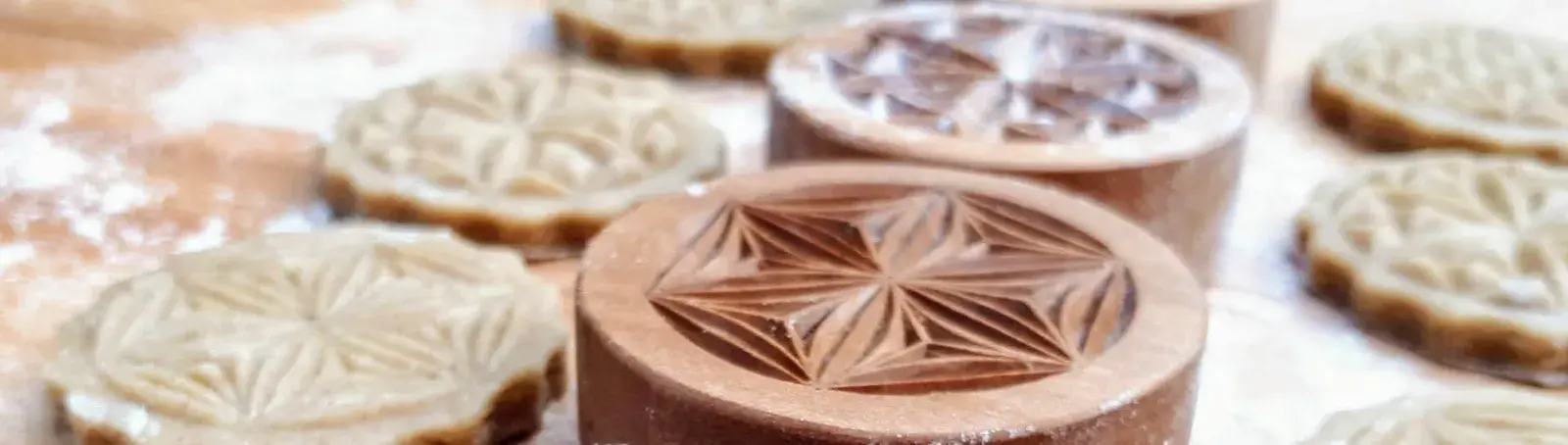
Gingerbread was expensive because honey and the flavouring spices imported from abroad would cost a lot. They had to meet high standards in taste but also regarding its form variety. Most of the time, male gingerbread makers would also make their own moulds. The gingerbread mould carved in the shape of a puppet, Hussar or heart — called 'ütőfa' in Hungarian — represents is one of the finest artifacts of our heritage, which is still used in modern folk art today.
The motifs and figures carved into the moulds often held symbolic meaning, which explains the presence of gods, saints, notable individuals, and princely emblems on historic wooden gingerbread moulds.
The round shape of the Debrecen plate was a popular and basic mould shape, while little boys would be quite keen to receive the sword and the horse-riding Hussar gingerbread figures. The gingerbread figure shaped like a baby in a swaddle was mostly purchased for young wives. Young men would buy the heart-shaped gingerbread piece for the lasses they were courting.
Among other old gingerbread specialities, we can find the rifle, the masked male figure, but also cradles, slippers, jugs, honey sticks and pipes.
Gingerbread came to Hungary through the Germans (Saxons) living in Transylvania. The term "honey scone" was first written down in 1554, and "honey puppet" in 1587. A famous Hungarian gingerbread-maker and mould-creator was called Imre Beliczay. The mould maker from the Hungarian Great Plain, Sándor Szikszay, learned his trade in Debrecen and worked in Békés, while the Petrics family operated and became well-known in Szekszárd. They would also make candles, candy and other sweets. The decline of the craft may have been caused by sugar production and the confectionery industry appearing in the 19th century.
A recipe of Judit Szmelo, gingerbread-maker and folk artisan:
Take 800 grammes of flour, 350 grammes of powdered sugar, 50 grammes of margarine, 4 whole eggs, 4 tablespoons of honey, 2 tablespoons of baking soda and 1 tablespoon of gingerbread spice mixture.
Sift through the flour, powdered sugar, baking soda and spices into a large bowl. Melt the margarine, and add the honey. Stir well. Put the eggs in this mixture and stir. Knead it, work it out well, nice and shiny, and let it rest in the fridge for some time from half an hour to a day. On a kneading board, roll out smaller portions of the dough to a thickness of half a centimetre with a kneading pin. Cut the forms with tin moulds and bake them at 180 degrees for 6-7 minutes.
You can decorate it with a glaze made from sugar and egg whites, or you can put different seeds and dried fruits on it as embellishment.
Nowadays, stamping, where the pattern is laid out of copper plates in the wooden stock and pressed into the dough and another old technique is "painting", where the coloured glazes is painted on the dough with a paintbrush, are little known.