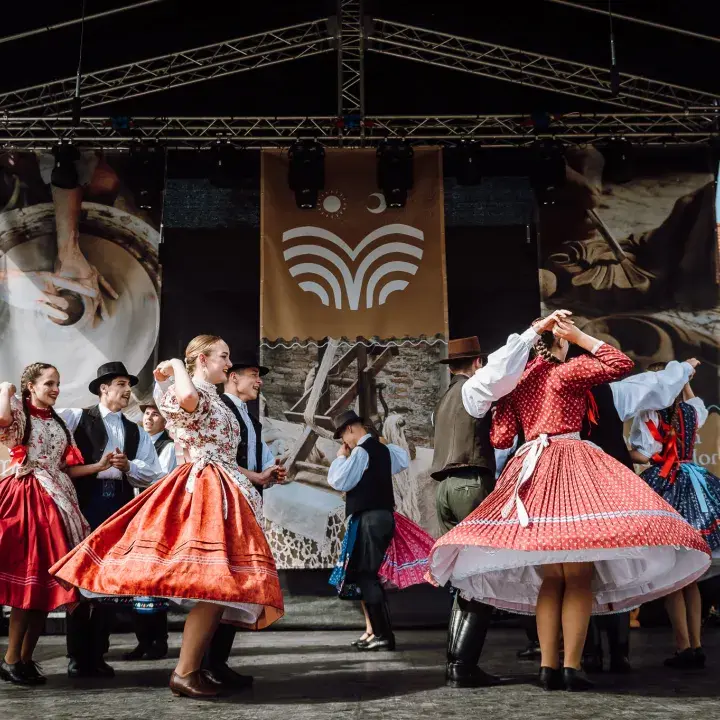
In the early 2000s, the artistic direction of the Hungarian State Folk Ensemble was shaped by fresh impulses. After the dramatic dance plays with László Melis's music – Örmény legenda (Armenian Legend) (2001), Veszett Világ (Wasted World) (2003), Szerelemtánc (Love Dance) (2003) – the company's visual and conceptual renewal was brought about by a new creative partner.
At this stage, Gerzson Péter Kovács emerged as a key choreographer, visual and light designer. Alongside Gábor Mihályi, his input helped shape the company's long-term artistic strategy.
The production A Földön apám fia volnék (On Earth my Father's Son I'd Be) in 2004, reinterpreted the dance traditions of the Carpathian Basin with contemporary theatrical means. The minimalist visuals - white floors, tulle curtains, black and white costumes – emphasised the passage between past and present.
Pannonian Fresco (2005) connected the dance cultures of Europe's different ethnicities, while Eternal Kalotaszeg and Highland Treasures later presented the encounter between authentic folklore and modern stage language.
Bittersweet (2009) depicted the tension between the country and the city ,between the homeland and another, chosen new home.
Labyrinth, presented as part of the Bartók Trilogy, was a stage reinterpretation of Bartók's mindset and attitudes. The music, featuring urban noises, dissonant sounds, and folk music motifs, was composed by László Sáry. The dancers sang, played rhythms, and used contemporary movement language simultaneously.
Altogether, these performances marked a new direction for the company: tradition appeared on stage not as a museum object, but as a vital contemporary theatrical language.