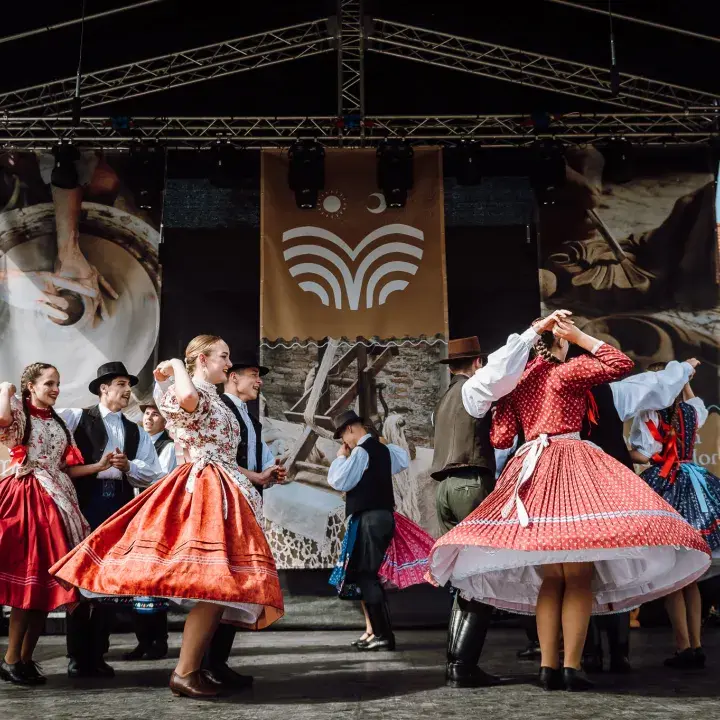
Gábor Mihályi is one of the dominant creators of Hungarian stage folk dance. His work is closely intertwined with the history of the Hungarian State Folk Ensemble, which he has shaped as its artistic director for more than three decades.
In 1996-97, he served as the ensemble's acting artistic director, and from 1998 to 2001, he directed the ensemble as a company director. From 2002 to 2016, he helped renew choreographic and performance work as artistic director, and since 2016, he has been the ensemble's director.
Throughout Mihályi's leadership, the Hungarian State Folk Ensemble has drawn from traditional folk dance roots while forging new paths. By blending folklore with contemporary theatre and modern aesthetics, he introduced a unique theatrical language that keeps tradition vibrant and relevant.
Formal education:
1992 - Hungarian Academy of Dance - folk dance instruction
2007 - Hungarian Academy of Dance - choreography
Awards and recognition
Kossuth Prize – 2023
Outstanding Artist Of Hungary – 2020
Best creator of the season–– 2019 (Liszt Mosaics)
Honorary citizen of Szolnok - 2019
Seregi Award – 2016
Meritorious Artist Of Hungary – 2014
Orbán Sipos Award – 2013
Best creator of the season–– 2013 (Dawn Moon)
Imre Zoltán Award – 2011
Permanent Member Of The Hungarian State Folk Ensemble – 2011
"Best creator of the season – 2009 (Bartók Trilogy II: Labyrinth)
EuroPAS Hungarian Dance Award – 2007
Best creator of the season – 2000 (Sun Legend)
Gyula Harangozó Award – 1996
Recognition of the Hungarian State Folk Ensemble under the leadership of Gábor Mihályi
- Budapest Award – 2014
- Prima Award and Prima Primissima Audience Award – 2007
- Béla Bartók Memorial Award – 2006
HSFE's shows between 1995 and 2025 (compilation)
The 1990s
1995 – Régen volt, soká lesz (It Was Long Ago, It Will Be A Long Time)– Elment a madárka (The Bird Has Flown)
1996 – Virágozzál cédrusfa levelen – Táncrapszódia (The Cedar Tree is in Bloom: a Dance Rhapsody)
1998 – Hármas tánctükör (Triple Dance Mirror); Ütik a rézdobot (Beat the Brass Drum - 1848 Memories
The 2000s
2000 – Táncos magyarok (Dancing Hungarians) – Tánc-millennium (Dance Millennium) ; Naplegenda (Sun Legend)
2001 – Örmény legenda (Armenian Legend)
2003 – Szerelemtánc (Love Dance); Veszett világ (Wasted World ; Verbunkos – Nemzeti tánc születése (Verbunk - The birth of National Dance)
2004 – Földön apám fia volnék (On Earth my Father’s Son I’d Be)
2005 – Pannon freskó (Pannonian Fresco)
2006 – Bartók-trilógia I.: Kincses Felvidék (Bartók Trilogy I: Highland Treasures); Magyar Concerto – Hommage à Bartók Béla (Hungarian Concerto)
2008 – Bartók-trilógia II.: Labirintus (Bartók Trilogy II: Labyrinth
2009 – Édeskeserű – Tánc erdélyi muzsikára (Bittersweet - Translylvanian Folk Dance)
The 2010s
2010 – Magyar rapszódia (Hungarian Rhapsody); Álomidő (Dreamtime)
2012 – Hajnali Hold (Dawn Moon)
2013 – Szarvasének – táncvers (Song of the Deer - dance poetry) ; Magyar rapszódia – Amerika (Hungarian Rhapsody - America)
2014 – Megidézett Kárpátalja – Hágókon innen és túl (Transcarpathia Invoked- Thence and over the Passes)
2016 – Apám ablakából az ég (The Sky from my Father's Window)
2017 – Tánckánon – Hommage à Kodály Zoltán (Dance Canon)
2018 – Liszt-mozaikok – Tánckoncert (Liszt Mosaics - Dance Concert); Csodaváró betlehemes (The Miracle of Christmas)
2019 – Ezerarcú Délvidék (Thousand-faced Vojvodina)– Kolozsvári piactéren (Kolozsvár Fair)
2020–2025
2020 – Közös ég alatt (Together under the Sky); Kárpát-medence antológia (An Anthology of the Carpathian Basin)
2021 – Körtánc (Round Dance); Idesereglik, ami tovatűnt (The Past Swarms Around)– Óda az énekes madárhoz (Ode to the Songbird)
2022 – Kivirágzott keresztfája (His Cross Blossomed); Ünnep (Celebration)
2023 – Nagyvárosi vándorok (Urban Roamers); Hajnali Hold (Dawn Moon); Ezerarcú Délvidék (Thousand-faced Vojvodina); Naplegenda (Sun Legend)
2024 – Édeskeserű (Bittersweet)
2025 – Gyökerek és szárnyak (Roots and Wings)