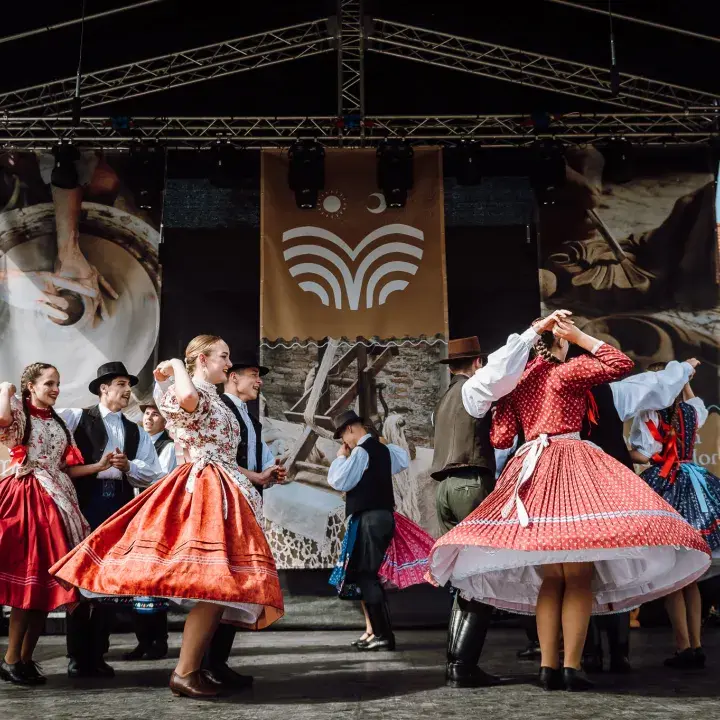
The Hungarian State Folk Ensemble stepped onto the international stage in 1951, the year it was founded. Their first performance abroad was in Czechoslovakia. From then on, tours became central to the ensemble's activities. Over the next two decades, the company showcased Hungarian folk dance art in many countries worldwide.
The ensemble's first major success in Western Europe was in 1955. During their French tour, they performed in Paris, Marseille, Nice, and Monte Carlo. The Paris premiere at the Empire Theatre, owned by Maurice Chevalier, featured 21 sold-out shows over three weeks. Ecseri lakodalom (Wedding at Ecser) was presented, but the gypsy dance was omitted to suit French sensibilities. The company was intentionally advertised on posters as the “Hungarian National Ballet”, a strategic choice that, despite some confusion, helped increase its appeal and audience reach.
The ensemble returned to France in 1957. During the tour, a unique scene unfolded when four young pairs of dancers held their wedding in Hungarian folk costumes from Kalocsa in Chennevières-sur-Marne, near Paris. This ceremony attracted the attention of the contemporary press. The mayor greeted the couples under the symbol of the Marne and the "Blue Danube." Among the world-famous artists attending was Ingrid Bergman. The wedding, evoking Hungarian traditions, featured chicken paprikash, painted eggs, and Hungarian spirits.
In the 1960s, the company's tours spanned several continents. In 1965, they began a three-and-a-half-month tour of Latin America, performing in cities across Mexico, Costa Rica, Panama, Colombia, and Brazil. These performances were more than artistic; the company also served as an ambassador of Hungarian culture.
The first North American tour followed in 1966. The ensemble performed in major cities across the United States and Canada, including New York, Los Angeles, Chicago, San Francisco, and Toronto. In these locations, advertisements also described the group as the “Hungarian National Ballet”. This was a conscious marketing ploy to help audiences accept and appreciate the stage genre of folk dance.
Between 1951 and 1971, the Hungarian State Folk Ensemble visited a total of 55 countries. Their tours were very successful. However, daily life during tours was modest; dancers received an allowance of only 33 HUF each day. Travelling was not always easy. The first bus tour to Czechoslovakia posed organisational challenges, and financial difficulties arose on some Latin American trips.
Despite these challenges, the company gained worldwide recognition. Their performances established Hungarian folk dance as both a national tradition and an internationally recognised stage art.