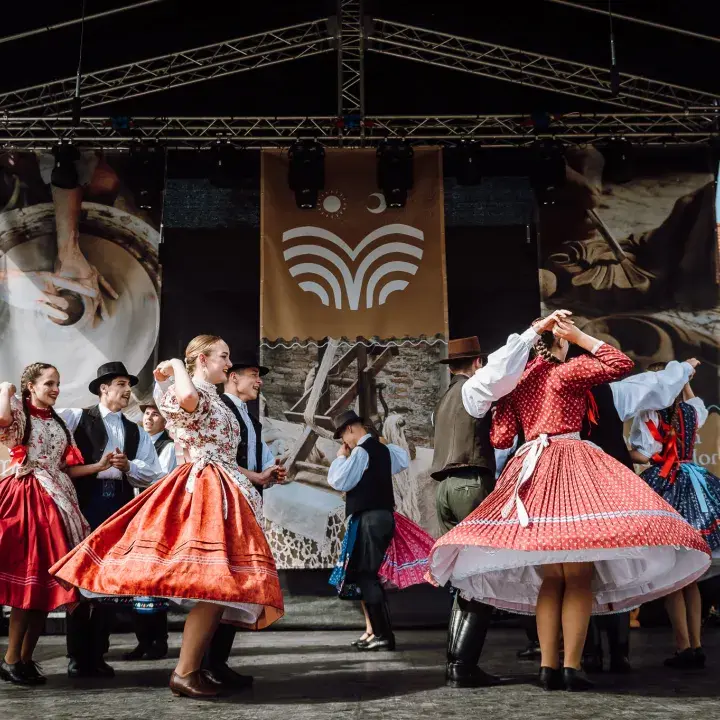
Miklós Rábai was the first choreographer and artistic director of the Hungarian State Folk Ensemble, founded in 1951. He focused on authentically preserving traditional folk dance while creating a modern stage art form.
Already, the ensemble's debut, Ecseri lakodalom (Wedding at Ecser), reflected this ambition. The unity of dance, singing, and music—the so-called "trio genre"—made its first fully staged appearance in this production. The show achieved worldwide success and exemplified Rábai's method: creating a new stage work from traditional motifs with deliberate construction.
Miklós Rábai recalled the show:
"I almost instinctively conceived the first show... When I realised what I had done, I barely dared to move for a while."
The ensemble debuted at the Opera House on 3 April 1951. They performed with the Moiseyev Ensemble, a choir of 90 members, 32 dancers, and 36 musicians. Ecseri lakodalom (Wedding at Ecser) and Este a fonóban (An Evening at the Spinning-House) immediately defined its artistic image.
The stage version of Ecseri lakodalom (Wedding at Ecser) lasted only ten minutes. In reality, a wedding in Ecser could last two or three days. Rábai created a condensed stage version using wedding motifs. Besides village dances, he included the verbunk of Uncle Józsi Murár, evoking the faded candle dance.
The piece quickly became one of the ensemble's best-known productions. It was performed almost 3,000 times in Hungary and abroad. The choreography was based on extensive fieldwork. Rábai had first staged an earlier version with the DISZ Central Ensemble.
In 1954, the play was also filmed in Ecser. The locals then saw the stage version for the first time, and it initially seemed strange to them. "It's not real," they said. Later, when they learned the show had reached worldwide stages, their pride grew. For a little while, Ecser felt like the "centre of the world."
In the second half of the 1950s, Rábai further expanded the stage possibilities of folk dance. In the fairy tale play Kisbojtár (Little Shepherd) (1956), folk dance was accompanied by pantomime and ballet elements, while in his later works, such as Barcsai szeretője (Barcsai’s Lover) and Jóka ördöge (The Devil of Jóka), the ballad and dramatic dance came to the fore. In these productions, folk motifs appeared already in a complex dramaturgical structure.
Rábai aimed to create a modern dance theatre rooted in folk traditions. As he said, folklore is not "a pinned, entomologically prepared dance butterfly" but a living, moving art.
Through his works, Rábai created a defining synthesis in the history of Hungarian folk dance on stage. He merged tradition, modern theatrical thought, and community culture.
From fairy tale to ballad
One of the first stops the new stage path defined by Miklós Rábai was Kisbojtár (Little Shepherd Boy), presented by the Hungarian State Folk Ensemble in March 1956. The libretto of the three-act play was written by Rezső Varjasi, while its music was composed by Lászlo Gulyás.
In the play, folk dance was joined by pantomime and ballet. These forms helped show the emotional and dramaturgical layers of the story. Critics called it a new genre, describing it as both promising and controversial.
After Kisbojtár (Little Shepherd Boy), Rábai continued to expand the genre's framework. In 1957-58, Barcsai szeretője (Barcsai's Lover) and Jóka ördöge (The Devil of Jóka) came about, in which the folk ballad and the dance came to the fore. Barcsai szeretője (Barcsai's Lover) evoked the tragic world of Szekler ballads, while Jóka ördöge (The Devil of Jóka) garnered great success as a dance comedy with humour and caricatured figures.
These works show the ensemble's development: choreography and dramaturgy grew closely unified. Drawing from tradition, the stage form expanded new possibilities for theatrical folk dance.