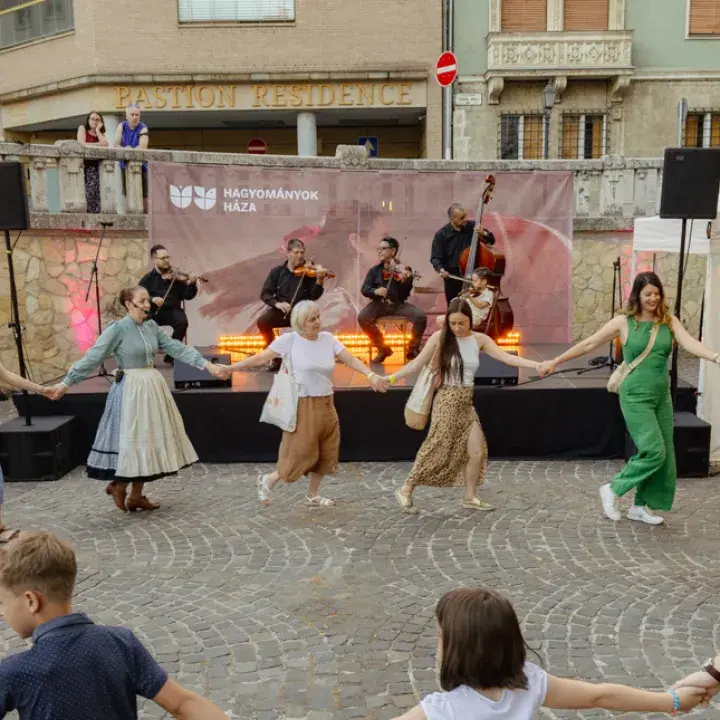
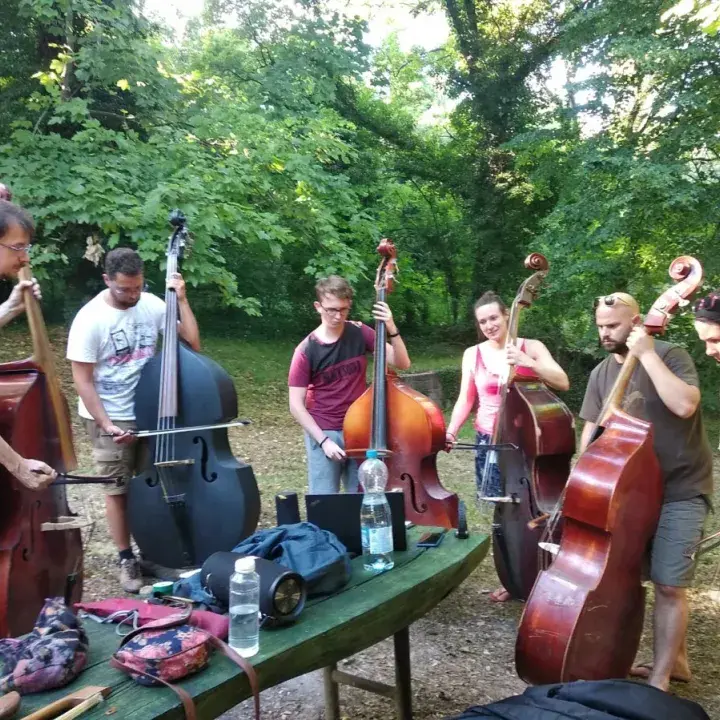
The Dance House movement, emerging in the 1970s, brought a fresh perspective to the Hungarian folk dance scene. It drew younger generations to the traditional rural culture of the Carpathian Basin and transformed centuries-old dance and music into modern community entertainment. The ethos of a "pure source"—an authentic, stylisation-free approach to folklore—transformed both community dance life and the mindset of stage folk dance.
Artistic credo
For Sándor Timár, folk dance was a living, changing system. It was closely related to music and to the skills and individual styles of the dancers. During his long research, he sought to reveal the internal laws of Hungarian folk dance. He aimed to pass these on to his students.
One important insight of folk dance research was formulated by György Martin: A significant part of Hungarian folk dances consists of solo or pair dances with an improvisational structure. To understand them, a detailed analysis of the movements and the motifs is required.
According to Martin, the motif is the smallest formal unit of dance, comparable to the word in spoken languages.
Familiarity with the motifs enables the dancers to improvise within the framework of tradition.
His main goal was to maintain the link between stage folk dance and community dance, and to ensure the dance's "authentic" values were not lost during staging.
Separation of the choir from the ensemble
The Hungarian State Folk Ensemble's repertoire combined dance, music, and singing, a unity Zoltán Kodály considered vital.
However, the system carried increasing tension.
As Miklós Rábai's works were kept unchanged, the coexistence of the three genres often proved difficult. After prolonged professional disputes, Sándor Timár separated the choir from the ensemble in 1985.
The decision raised serious objections. The change was seen by many as a violation of tradition, and the debates were not confined to professional circles but also played out in the public eye through newspaper articles, open letters, and public opinion.
In 1983, the ensemble's management submitted a five-year plan that several composers and artists, including Emil Petrovich, Sándor Szokolay, and Géza Körtvélyes, criticised for overshadowing musical and choral traditions.
The controversy showed that Timár was in a difficult situation: he had to preserve traditions while also renewing the ensemble.