With Busó Carnival approaching, travelers can meet Busós at the airport
We are in the middle of the carnival season, and the Busó Carnival in Mohács is fast approaching, filling the city in southern Hungary with life for six days at the end of February. This year, the folk custom of burying winter and welcoming spring will not only be celebrated in Mohács, but also at the capital's airport: as part of a series showcasing Hungarian culture, travelers will be able to meet busós and learn about the traditions associated with them.
The busó tradition originates from the carnival masquerade and dramatic folk tradition of the 'Sokacs', a predominantly Roman Catholic South Slavic people living in and around Mohács. Known as 'poklade' in Croatian, the custom is linked to the carnival season and is the most spectacular event of the carnival period, which lasts from Epiphany to Ash Wednesday. The Mohács Busó Carnival was added to UNESCO's Representative List of the Intangible Cultural Heritage of Humanity in 2009 and has been considered a Hungaricum since 2012.
The roots of this folk custom date back to the Sokac communities that settled in the Balkans. Similar masked winter-chasing figures are known in many parts of Europe, with the Hungarian busó masks being particularly close to the Bulgarian-Turkish kukeri. The first written records of the Busó Carnival in Mohács date back to the end of the 18th century, but it took on its present form in the local Croatian cultural circle.
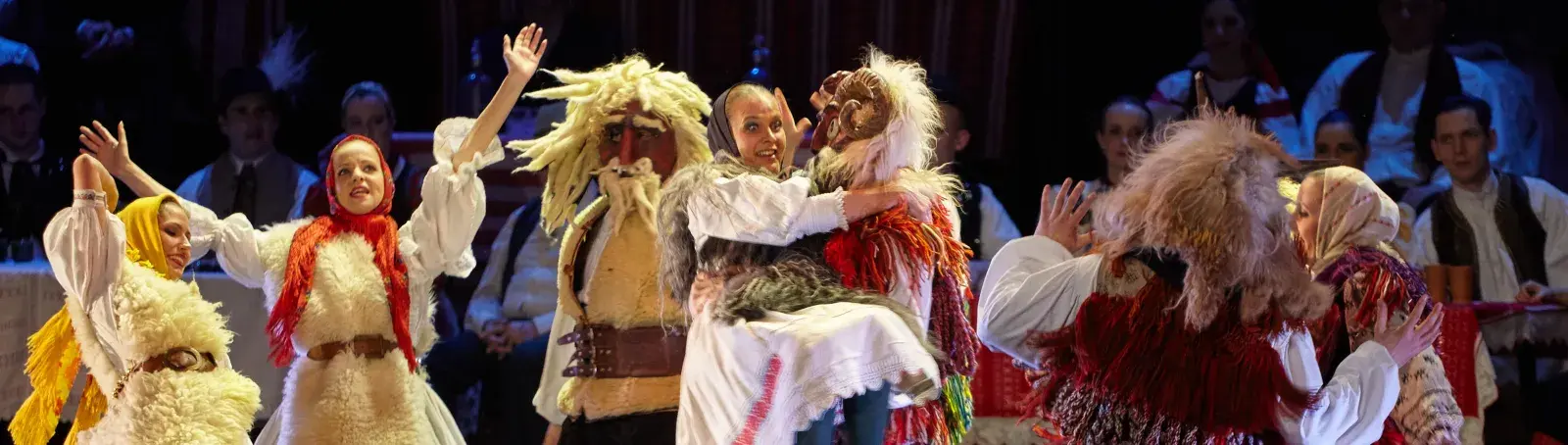
The characteristic attire of the busós consists of a mask carved from willow wood, often painted with animal blood, an inside-out sheepskin coat, white linen trousers, and clogs or boots. Their costumes are complemented by bells, chains, and bags, and their props include rattles, maces, and long wooden horns. During the carnival season, the actions of the busós are interpreted as a special, ritualistic "suspended" state, which offers a unique form of community involvement and self-expression.
The highlight of the Mohács Busó Festival is the "farsang farka," the three days from Carnival Sunday to Shrove Tuesday. During this time, more than five hundred busós arrive on boats across the Danube, followed by a costume parade with fantasy floats, horse-drawn carriages, and motorcycles. In the main square, a coffin symbolizing winter is burned on a bonfire, and the city celebrates with music, dancing, fairs, and community festivities. The program includes children's costume contests, a craft fair, and mask carving demonstrations.
Today, the tradition has grown beyond a simple folk custom: it has become a symbol of the city and, in a broader sense, of national cultural identity. With the active participation of busó groups, mask carvers, and costume makers, it is passed on to younger generations as a living heritage. This living tradition is now being evoked by the airport display, which presents one of the best-known figures of Hungarian folk culture to travelers during the carnival season, giving them a taste of the atmosphere of the upcoming Busó festival in Mohács.