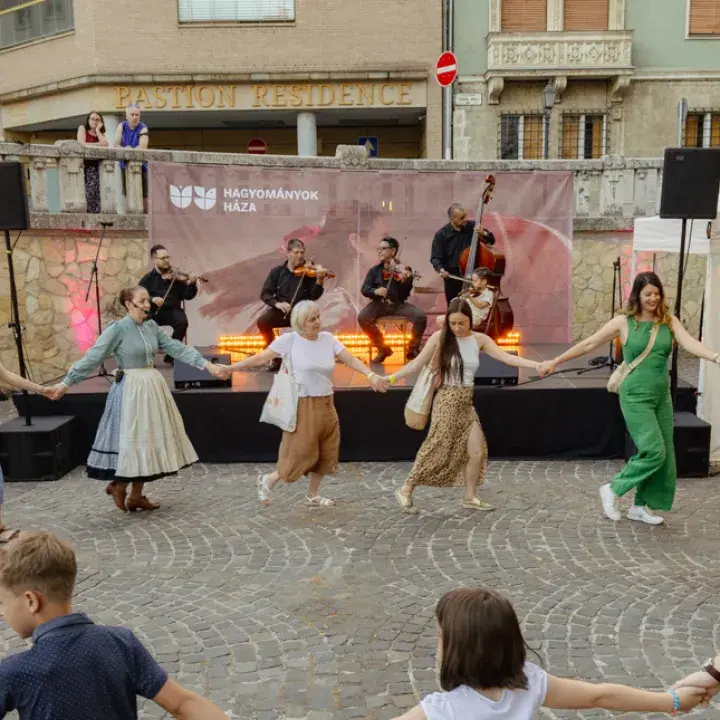
The Hungarian State Folk Ensemble emerged as the Hungarian folk dance scene between World Wars I and II embraced two dominant trends: the Gyöngyösbokréta (Pearl Bouquet) movement and the Regöscserkészet (Folk Scouts).
Specifically, Gyöngyösbokréta aimed to showcase authentic village traditions on stage, while Regöscserkészet focused on collecting, interpreting, and reimagining peasant culture for communal and educational aims.
The Békéscsaba Batsányi Ensemble came from the latter, which was led by Miklós Rábai after World War II. Rábai respected the tradition of folk dance but did not consider authenticity as an exclusive value. The most important aims for him were liveliness, accessibility for everyone and effectiveness on stage.
Building on Rábai’s philosophy, folk dance became increasingly consciously designed choreography and a distinct stage language. This path led to the formation of the Hungarian State Folk Ensemble through the MEFESZ and DISZ central dance ensembles.
The ensemble was established on 31 March, 1951, in accordance with the Council of Ministers' founding charter, with the aim of presenting Hungarian folk dance, folk music, and choral culture at a high standard and serving as a model for the Hungarian amateur folk movement.
Two Soviet models served as best practices in defining the artistic direction: the Pyatnitsky Choir, which was more traditional, and Igor Moyseev's Ensemble, known for its spectacular stage choreographies.
Rábai's agenda navigated these influences: preserving the spirit of Hungarian rural dance while integrating folk dance into a distinctive stage language. This evolution gave rise to a genre later known as "folk ballet".